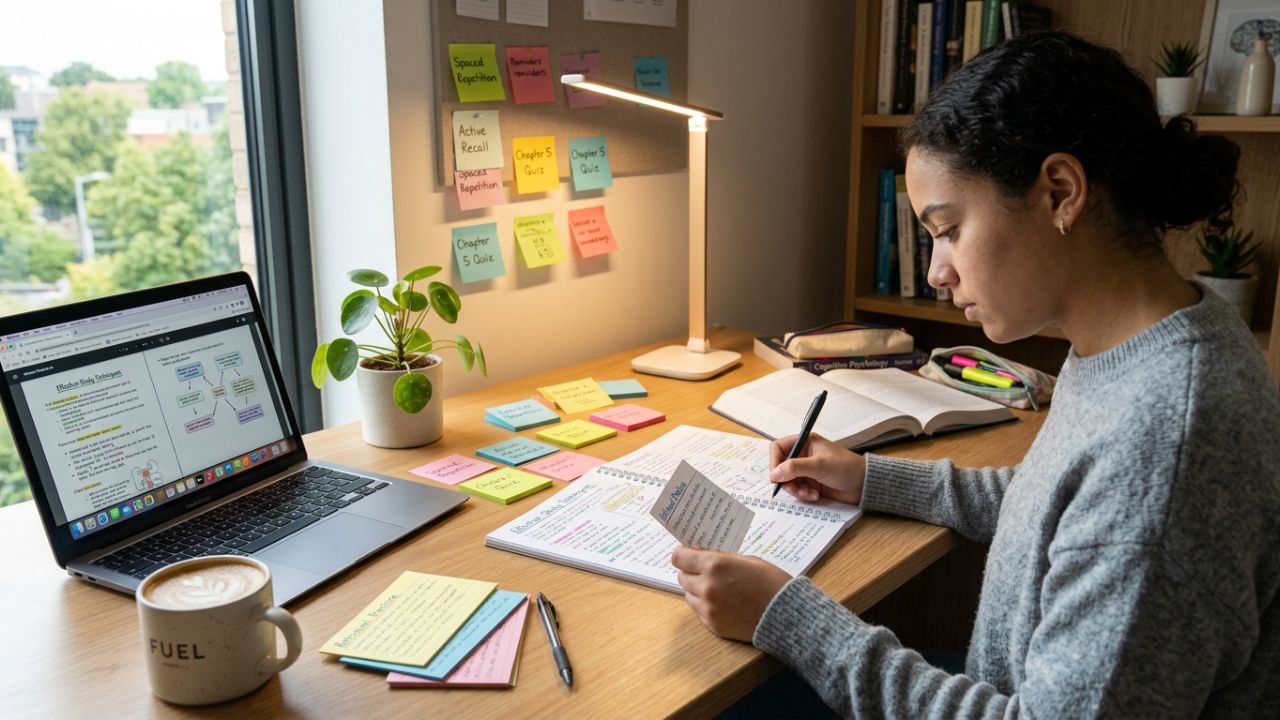
Studying harder doesn’t always mean studying smarter. Many students spend long hours with their books but still struggle to remember what they learned. The truth is that using the right study techniques that actually work can make a huge difference in how effectively you learn and retain information.
In 2026, learning strategies are evolving with new research on how the brain processes and remembers information. Instead of relying on outdated methods like rereading notes repeatedly, students are now using smarter techniques that improve memory, focus, and understanding. In this article, we’ll explore some of the most effective study techniques that actually work and help students perform better in exams and real learning situations.
1. Active Recall: Test Your Brain
One of the most powerful study techniques that actually work is active recall. Instead of passively reading your notes, this method encourages you to actively retrieve information from your memory.
For example, after studying a chapter, close your book and try to write down everything you remember. You can also use flashcards or ask yourself questions about the topic.
Active recall strengthens neural connections in the brain, making it easier to remember information later. Research shows that students who test themselves regularly remember significantly more than those who only reread their notes.
Tips & Tools – The Learning Center
2. Spaced Repetition: Study Over Time
Another proven strategy is spaced repetition. This technique involves reviewing information at increasing intervals instead of cramming everything at once.
For instance, you might review a topic today, then again after two days, then a week later. Each review reinforces your memory and prevents forgetting.
Spaced repetition is widely considered one of the most effective study techniques that actually work, especially for subjects that require memorization such as languages, science terms, and historical facts.
3. The Pomodoro Technique for Better Focus
Maintaining focus while studying can be challenging, especially with distractions like social media and smartphones. The Pomodoro Technique helps solve this problem by breaking study sessions into short, focused intervals.
The basic method works like this:
- Study for 25 minutes
- Take a 5-minute break
- Repeat this cycle four times
- Take a longer break after four sessions
This method prevents mental fatigue and keeps your brain fresh and productive. Many students find that this simple approach dramatically improves concentration.
4. Teaching What You Learn
One of the simplest study techniques that actually work is teaching the material to someone else. When you explain a concept, your brain processes the information more deeply.
You can teach a friend, explain the topic to a family member, or even pretend you are teaching an imaginary class. If you struggle to explain something clearly, it usually means you need to review that topic again.
This method, often called the “Feynman Technique,” helps identify knowledge gaps and strengthens understanding.
5. Practice With Real Problems
Reading theory is important, but practice is essential. Solving problems, answering practice questions, and taking mock tests help reinforce learning.
For subjects like mathematics, science, and competitive exams, practicing real questions helps students understand how concepts are applied in different situations.
Practice testing is widely recognized as one of the most reliable study techniques that actually work because it simulates exam conditions and improves confidence.
6. Create a Distraction-Free Study Environment
Your study environment has a big impact on how well you focus. A clean, quiet, and organized workspace can improve concentration and productivity.
Here are a few simple tips:
- Keep your study desk organized
- Turn off unnecessary notifications
- Use website blockers if needed
- Choose a quiet location for studying
By reducing distractions, you allow your brain to stay focused on learning.
7. Use Visual Learning Techniques
Not everyone learns best by reading long paragraphs. Visual learning methods like diagrams, mind maps, and charts can make studying easier and more engaging.
For example, creating a mind map of a chapter can help you connect ideas and remember key concepts more effectively. Visual learning is especially useful for subjects with complex information.
This method is increasingly popular because it turns large amounts of information into simple and memorable structures.
Final Thoughts
Success in academics doesn’t depend only on intelligence or long study hours. It largely depends on using the right study techniques that actually work. Methods like active recall, spaced repetition, practice testing, and focused study sessions can significantly improve how students learn and retain information.
By adopting these strategies and studying consistently, students can reduce stress, improve exam performance, and develop better learning habits for the future. The key is to experiment with different techniques and discover which ones work best for you.
FAQ
1. What are the best study techniques that actually work?
Some of the most effective techniques include active recall, spaced repetition, practice testing, teaching others, and using the Pomodoro study method.
2. How many hours should a student study each day?
The number of hours varies, but focused study sessions of 2–4 hours with proper breaks are often more effective than long, unfocused study periods.
3. Is rereading notes an effective study method?
Rereading alone is usually not very effective. Techniques like active recall and practice testing are much better for long-term memory.
4. How can I stay focused while studying?
You can improve focus by using time management methods like the Pomodoro Technique, studying in a quiet environment, and limiting distractions from phones or social media.
5. Do study techniques really make a difference?
Yes. Using proven study techniques that actually work can improve memory, understanding, and exam performance while reducing the amount of time needed to study.
Read More:
https://technixt.com/others/best-free-productivity-apps-for-students/
https://technixt.com/others/digital-marketing/how-to-build-a-high-converting-landing-page/