You think buying a “20,000mAh” power bank means 20,000mAh usable power? Think again.
Let’s reveal the power bank real capacity truth that brands don’t want you to know.
Why This Matters: Your Power Bank Isn’t What It Says
Every year millions buy a portable charger expecting full-day backup. But when it comes to the power bank real capacity, marketing often exaggerates specs.
- Brands list big numbers (e.g., “20,000mAh”)
- But actual usable output is far less
- It’s based on internal battery specs, not what actually charges your device
This isn’t fraud. It’s just how batteries work.
👉 Keep reading if you want the truth behind the numbers — and how you can pick the right real-capacity power bank for your needs.
🔍 The Power Bank Real Capacity Breakdown (Quick & Raw)
🔌 What You See vs What You Get
Most power banks show internal cell mAh (usually at ~3.7V).
But your phone charges at 5V USB output — and that requires voltage boosting, which wastes energy.
Here’s the shocker:
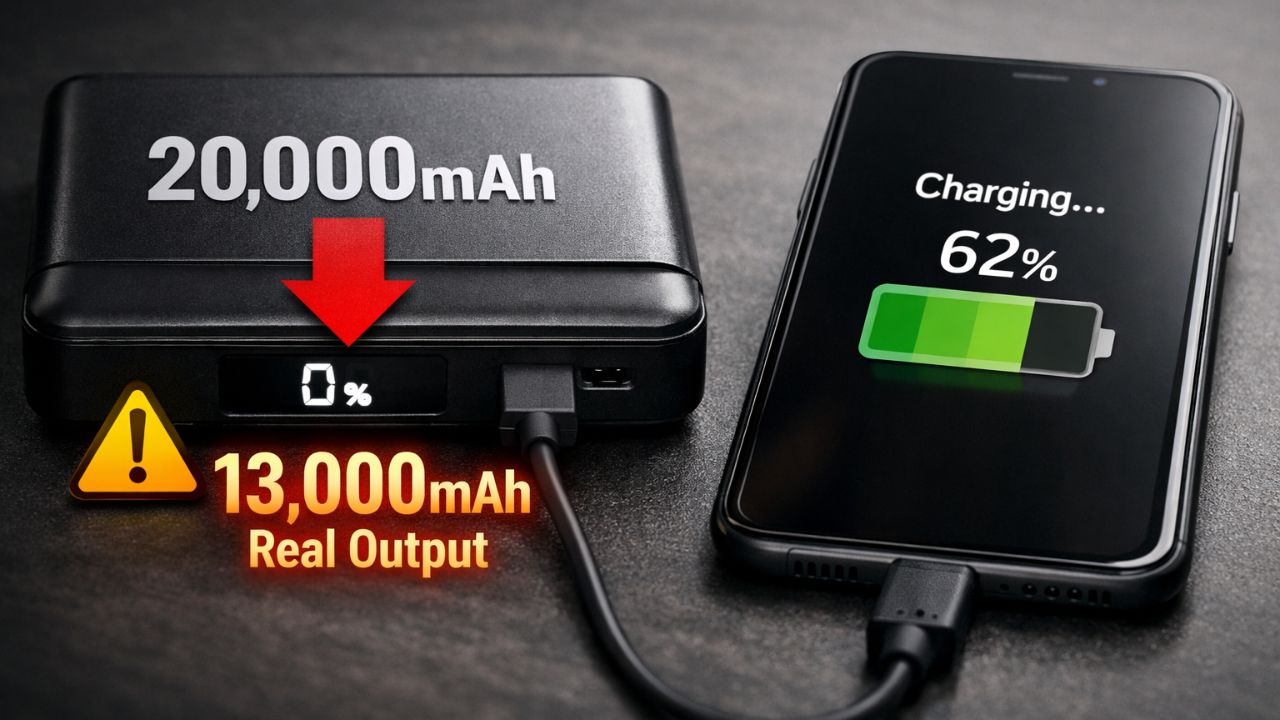
➡️ A 20,000mAh power bank often delivers only 12,000–14,000mAh usable power in real-world charging.
Why?
- Voltage conversion losses
- Efficiency limits (typically ~80–90%)
- Heat + circuit waste
- Cable / port power losses
⚠️ That’s 30–40% less power than the box says!
🧪 Real Charging Results (Actual Tests)
When tested with real devices and USB testers:
✔️ A “20,000mAh” power bank often gives only 13,000–14,000mAh real output.
✔️ Some cheap units deliver below 60% of the rated figure.
Remember:
📊 Rated Capacity ≠ Power Bank Real Capacity
This is why your phone might charge only 2–3 times, not 4 or 5.
🛠️ How Power Bank Real Capacity Is Calculated
The scientific way:
Actual Usable Capacity ≈ (3.7V × Advertised mAh × Efficiency %) ÷ 5V
Example:
A “10,000mAh” bank at 85% efficiency delivers around 6,290mAh usable.
Experts and testers often use USB watt-meters to measure output in real life.
📌 Best Practices — What to Look For
✅ 1. Look for Rated Output / Wh Labels
Power banks that list Wh (watt-hours) show closer to the real capacity.
✅ 2. Check Output Efficiency
Good quality cells + converter = more usable power.
✅ 3. Avoid Too-Good-To-Be-True Numbers
If a palm-sized bank claims absurd mAh — be skeptical.
✅ 4. Consider Conversion Safety
Better brands stick to safe materials + regulated power delivery.
🔋 Top Suggested Power Banks (Realistic Performance)
Here are some real-world dependable options with better reputation and performance for their size:
📌 Daily & Reliable (Best Overall)
- Samsung 45W‑20000 mAh Power Bank – High reviews, strong output, delivers closer to usable capacity thanks to quality build and higher efficiency.
Link : Samsung 20000 mAh 45 W Power Bank Price in India - Stuffcool Click 20000mAh Magnetic Wireless Powerbank – Great magnetic option with trustworthy performance.
Link : Stuffcool Click 20000mAh Magnetic Wireless Powerbank
🔌 Balanced & Affordable
- Xiaomi 4i 20000 mAh 33W Fast Charging Power Bank – Good balance of fast charging and real output.
- boAt Energyshroom PB400 Power Bank – Budget-friendly choice with solid usable power.
⚠️ Recommended to avoid overly cheap ones unless you test the power bank real capacity yourself, because reviews often show low usable output. (e.g., super-budget power banks sometimes fail to deliver expected results).
❗ Common Myths About Power Bank Numbers
| Myth | Reality |
|---|---|
| Bigger mAh always means more charges | No — usable output varies with efficiency |
| All 20,000mAh power banks are equal | Not true — build quality matters |
| Fast charging drains capacity faster | Fast charging protocols can reduce efficiency slightly |
🤔 FAQs — Everything You Need to Know
What is power bank real capacity?
Answer: It’s the actual usable power you get for charging devices — not the number printed on the box. It’s always lower due to voltage conversion losses and inefficiencies.
Why does a 20,000mAh power bank only show ~12,000–14,000mAh output?
Answer: Because internal battery voltage (~3.7V) must be boosted to USB output (~5V), wasting energy in the process.
How can I test power bank real capacity at home?
Answer: Use a USB power meter or multimeter + dummy load to measure output during a full discharge cycle.
Are expensive power banks always better?
Answer: Not always — but reputable brands generally have better efficiency and real-world output.
Does a heavier power bank mean more real capacity?
Answer: Often yes — heavier units usually house larger or denser cells, meaning more real output.
🔥 Final Takeaway
If you want real, day-to-day backup, don’t trust just the marketing mAh number.
➡️ Always focus on power bank real capacity — the real usable juice — not the inflated advertised claim.
Because in the real world?
📱 You want reliable charges,
🔋 not empty promises.
Read More :
This One Student Laptop Upgrade Made Studying 10x Easier for Me – technixt.com
Best Earbuds for Calls in 2026: I Tested Them on Daily Work Calls – technixt.com